Previously we covered how our Repair Cafe got started, and now we want to share the nuts and bolts of how the Repair Cafe works.
Participant’s perspective
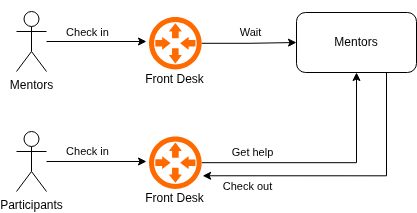
If you have something that you want fixed the general process will be to show up, check in, work with a mentor, check out. If you have multiple things to repair, repeat the process with your next object.
- Show up
- The Makerspace is on the lower level of the IMC
- The ramp entrance is on the north side of the building (Elm Street)
- See our event page for a nice map
- Check in
- Tell the front desk what your item is and what’s wrong with it. They’ll start filling out a repair form and figure out which mentor have the skills you need.
- Feel free to print the form at home and start filling it out if you want to speed up the check in process
- Work with the mentor
- If you’re comfortable fixing things yourself and just having the mentor there to ask questions when you’re not sure if you’re on the right track, great, we can do that.
- If you don’t know where to start, that’d cool too, we got you! The mentor will explain what we’re doing and why so you can get familiar with the process of fixing arbitrary things
- We encourage you to do some of the steps, and the mentor will take care of anything you’re not comfortable doing (e.g. soldering electronics together)
- Check out
- We keep track of how many objects come through our Repair Cafe, what they were, and whether they could be repaired. Checking out makes sure we are able to capture that data
- You can see our dashboard to get an idea of:
- How likely different types of things are to be able to be fixed
- Which brands are more repairable
We want to keep everything as simple as possible. That’s why we don’t take reservations. Instead, we help whoever shows up in the order of arrival (and availability of a mentor with the appropriate skills). This keeps the overhead down for us as all the volunteers can just show up at the event and when the event’s over, we’re not on the hook to schedule people for specific times. Plus, we don’t know which mentors are going to be available on any given day, so we can’t guarantee that there will be someone with the specific skills to help you work on your item.
If you have questions about whether we’re likely going to be able to repair something, or want advice, please ask on the mailing list. There are plenty of people who might be able to let you know what parts you will need to buy before they even diagnose it. Please keep in mind that we’re a small group of busy people, and not all of us check our email every day, so it might take a few days for someone to get back to you.
What we accept
This is one of the most common questions we get and the answer is that we will attempt to repair anything you can bring us. We’ve had clothing, a coffee table, model train equipment, tablets, kitchen equipment, lawn care equipment, and more. To help you think of things you might have that aren’t working quite right, here’s an incomplete list of some examples of things you might want fixed:
- Household electrical items
- Display and sound equipment
- Tools (electric or non-electric)
- Toys (electric or non-electric)
- Computer equipment
- Mobile phones
- Clothing
- Textiles
- Household items non-electric
- Clocks
- Furniture
We don’t currently have a welder that lives at the Makerspace, but we do have a mentor who is willing to bring in their welder and safety gear a couple times a year. When the welder will be there, we’ll announce it ahead of time on the mailing list. We do have JB Weld and epoxies, so we can fix most things without a welder.
The only thing we don’t accept is people dumping off their broken items for us to fix or dispose of. We understand that not everyone wants to be involved in the repair process, and that’s fine, but that’s not how we operate. If you want to have someone fix something for you, we’d encourage you to either find a friend who is willing to fix it at the repair cafe, or take it to a business that repairs that type of thing.
Mentor’s perspective
We try to make the process as easy as possible for mentors (and everyone, really). Just show up with a positive attitude. There’s no coordination required, you don’t need to sign up for a time slot or anything like that. If you want to bring your own tools you can, but we have a decent supply at the Makerspace.
Mentors check in at the front desk and state what types of repairs they’re comfortable doing (e.g. mechanical, textiles, electronics, etc.). Mentors are here to help teach you how to repair things. That doesn’t mean that if someone brings in a broken TV that they’ll walk out being an expert TV repair-person, but they might be able to identify TVs that are broken in the same way in the future.
While you’re not expected to do everything for the participant, there are some tasks which require skills that they might not have (soldering, precise drilling, winding a bobbin, etc.). Frequently people will be nervous about trying something for the first time and will want you to do it. Hopefully they will come back in the future and be willing to give it a try over time.
It’s also worth noting that when the event starts we never know how busy we will be. If you have anything that is broken and want to fix it between helping others, you’re encouraged to do so. And if you have something that you don’t know how to fix (e.g. you’re an electronics person and know little about mending garments), bring it in and maybe someone else can work on it in their slack time. And it’s always possible that there won’t be any slack time, so that’s something to keep in mind.
Paperwork
Earlier we mentioned that participants and mentors will fill out a repair form. You might be wondering, what’s up with that? That sounds like more of a bureaucracy than keeping things as simple as possible! Fair point. This is one of those places where a little extra work results in a substantial benefit to society. We enter all this information into Repair Monitor which makes the data accessible to everyone. This allows people to see what types of objects and brands are repairable here, specifically at our Repair Cafe, given the tools, parts and mentors that we have in our own community.
Many of our core volunteers are also staunch privacy advocates, which is why we don’t require you to provide your name or any information about yourself. We enter the data online and then shred all the paperwork after every event. If you’re a mentor, we don’t enter your full name into the database. We’ll use your first name, initials, or we can just enter “anon” in that field.
Pure chaos?
You may be thinking: No coordination, no idea who is going to show up each month, no fundraising, no profit motive, no leader telling people what to do? That sounds like pure chaos! Yeah, to some degree that’s true.
But when you think about it, it’s not much different than the farmer’s market. Each farmer doesn’t know who else will show up, nor do customers know what will be available until they get there. At the same time, they have some guesses about what’s in season and who the regulars are.
It’s similar with the Repair Cafe. We can expect that there will be some sort of electronic and mechanical repairs each month. After a few sessions people find a groove and it really works a lot more smoothly than one might expect.
We’re not here to be a traditional business. We’re building something new. At the end of the day, our local community will either appreciate this service enough to chip in, or they won’t. And when we say “chip in” we primarily mean participation, but also donating tools and materials, and lastly money. We collectively decide how rigid we want our structure to be and right now it’s very egalitarian with people helping wherever they see a need that is a good fit for their skills and capacity. In the future we could decide to have a schedule and dedicated roles such as outreach, scheduling who will be at which event and so forth. At the moment, that seems like a lot of extra work, so we’re all just doing the parts that we enjoy (or at least where the benefit is worth the time and effort).
How to get involved
At the bottom of our origin story, we go into detail about how people can support the Repair Cafe. The short version is:
- Tell your friends, congregation, environmental or engineering groups your involved with… everyone!
- Bring in things to repair (or just come hang out with us)
- Become a mentor (or encourage a friend to do so)
- Donate materials (our most wanted list is always on our event page)
No responses yet